Travel is therapeutic, we all know that. For those of us who value its presence in our lives, seldom do we find a way to express it. As far as I can imagine, this picture personifies travel like no other. Enjoy.
Travel was my dream,
travel is my life.
I travel even if there is nothing to take me there,
and even if there was no other way,
I would just keep walking.
Shot in Africa, on the island of Zanzibar. Sunrise on the east coast here is like nowhere else. Dramatic and fulfilling.
Want to see more pictures from Zanzibar? Click here.
It’s that time of year again. The mountains will soon echo with the sound of motorcycle engines. Hundreds of people will leave their homes and comfort zones alike, taking charge of their existence with the help of two wheels!
Serenading Mountains
The things in life one decides to do before it’s too late are many. For a freakishly increasing number of motorcyclists in India, riding to Khardung La aka the Khardung pass a little distance from the town of Leh in Jammu & Kashmir, is the ultimate achievement.
To Khardung La!
It is a very personal experience and an equally personal endeavour, this. The Khardung La is located at a height of about 18380 Ft, on the way to the desert towns of Disket and Hunder. From the high altitude town of Leh (11000 Ft), the mountain pass is about 50 kilometres away.
If you think there are things in life more important than riding a motorcycle over maddeningly bad terrain and beautifully dangerous roads to the highest motor-able road in the world, just ask any Royal Enfield (Bullet) rider. She/he will surely set your thoughts straight.
Into The Mountains
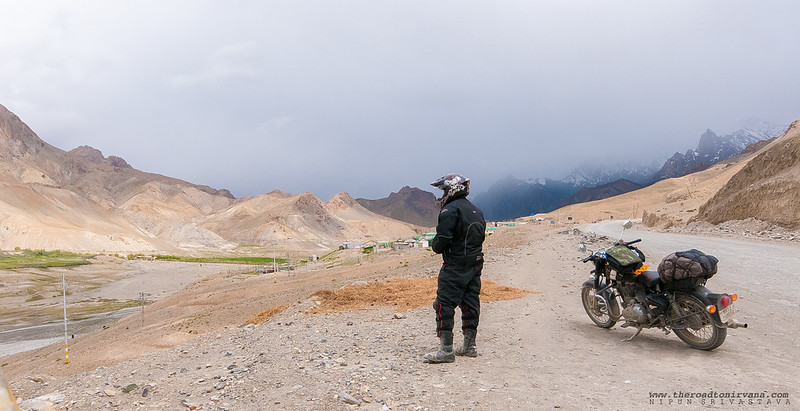
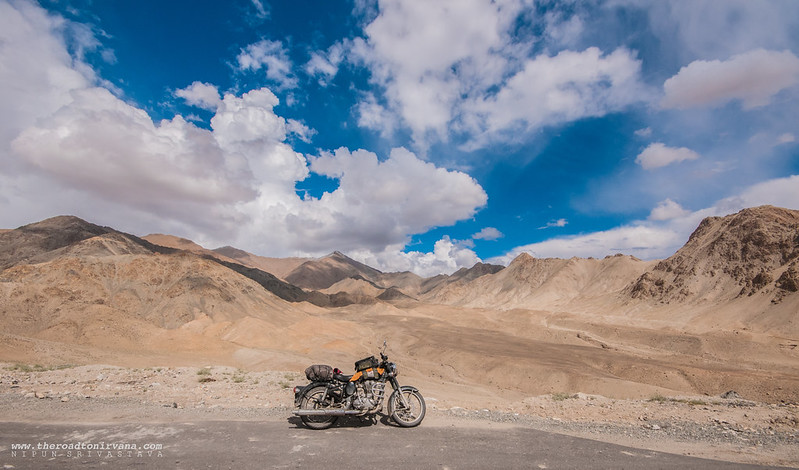
For most bikers, riding in Ladakh on the mountain roads which wind their way through the Himalayas is a challenge. Everybody can do it but not everybody does. It takes courage of a different kind to actually set out on this special road trip. The hurdles a motorcycle and its rider face when on these high altitude roads are positively uncountable. Mind you, that is a major reason why one sets out on most adventures, isn’t it?
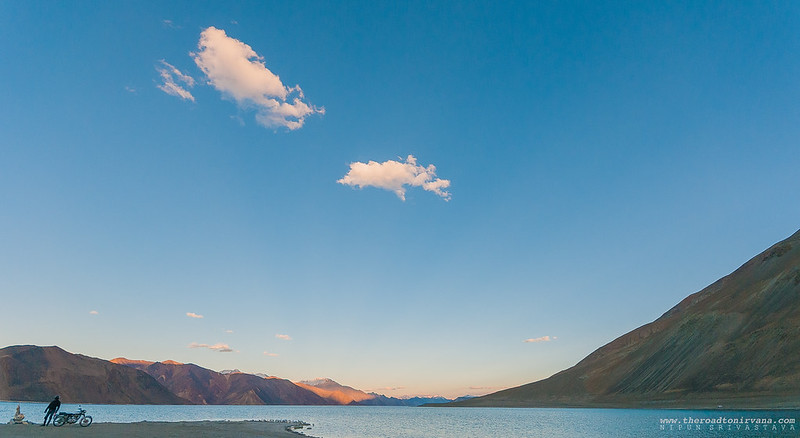
Night in the mountains.
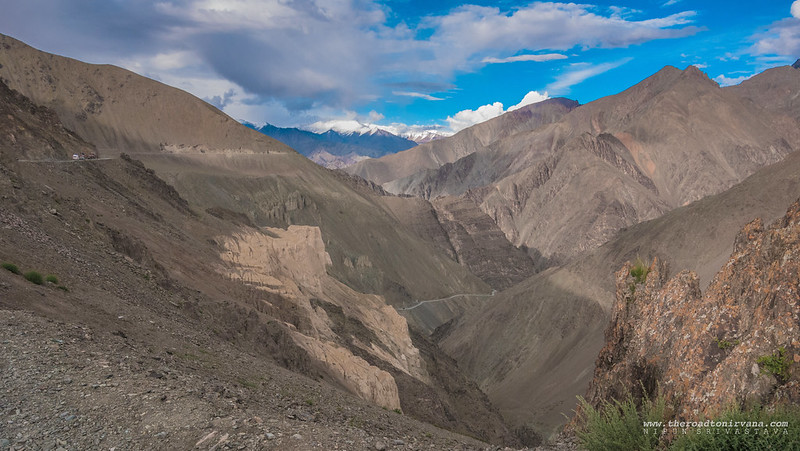
Controlling a motorcycle while riding through slush, gravel, sand and even torrential streams are just some of the things a person on this endeavour will have to endure. Not undermining the fact that high altitude always has nasty surprises up its sleeve, if you aren’t acclimatised properly. The air is thin up there, oxygen is less and so is the room for error while riding on the ultra-narrow roads. Almost 85 % of the roads are mountainous where on one side is the mountain itself and the other side is a cliff or a raging river and no, seldom will you find any barricading to save you, if you’re planning on going over i.e.
Long way down!
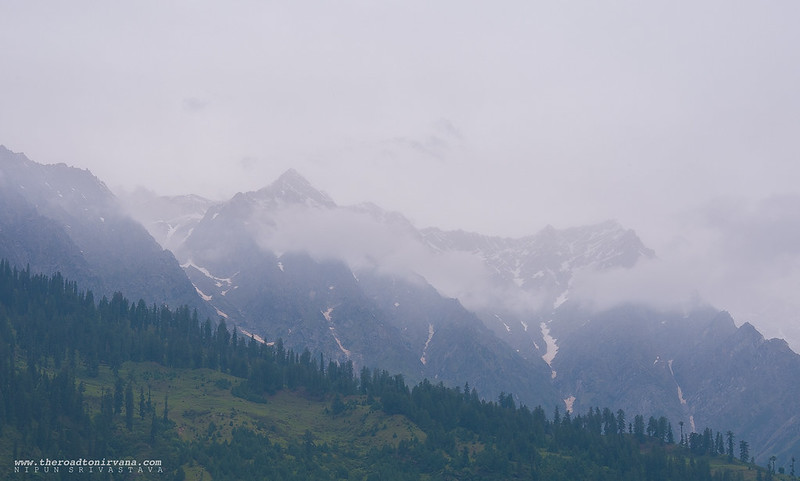
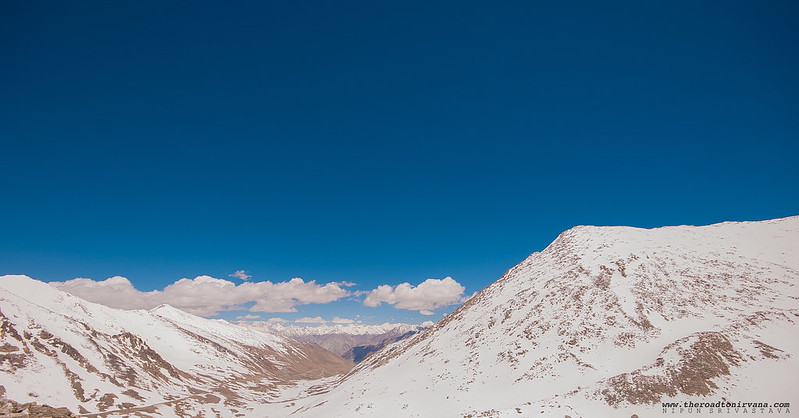
One can never underestimate the power of the weather here. They say ‘If you don’t like the weather in Ladakh, just wait five minutes’ and it is actually true. The weather can change with every blink over the Ladakhi landscape. You will be treated to ice cold rain and snow, winds fast enough to throw you off your feet and people who are as beautiful as they are calm.
Whacky Weather!
Whether you ride solo or you ride with a bunch of people like yourself, this adventure will affect you as an individual. Call it philosophy or call it spirituality, either way, you will be a changed person by the time you reach home. Many have said before that the isolated existence and the feeling of being removed from the ruckus of everyday life is the real reason why people go to this place. There is a lot more to Ladakh than just that. It is that place where no matter what your age, you will meet yourself, the real you.
Absolute Isolation
We’re not going to talk about how one should take this trip. Frankly, we have no right. Do take the trip if you get a chance though. Leave that chair, head out, stretch right up and touch the sky.
What it means for travel: Nothing of the ordinary, far from it.
In today’s day and age, tourism is full of lavish and luxurious holiday packages, which cater to a select segment of society.
Travel though, contrary to what some people believe, is becoming increasingly easy. It is easier to get around, more independence, more resources and the urge to explore is a common character trait in most individuals. Yet, when it comes to actually pulling all the stops and heading out, most settle for true blue/tried and tested travel planning.
When you sign up for such travels, you make sure (in most cases) that you don’t experience even a bit of the ‘extraordinary’ that this world has to offer. Since everything is researched and surveyed, seldom will you venture out of your comfort zone.
Backpacking is one way the young and vibrant excuse themselves of the cliché and do what they feel like with travel in a budget. A very good practice, that. Though, what about the people who have the money? Who don’t have a pressing need to save on flights and accommodation, what about them? Some would argue that such people don’t really want a special experience, they just want to relax and get away from it all. I disagree.
The majority of people I have spoken to tell me that they would have liked a more engaging vacation. Wanting not just the opportunity to sit in a hot tub and drink beer but also the chance to really get wet with perspiration, leaving footprints at places no traveller has gone before. Wouldn’t you like the same?
Take for instance, the time I spent in Africa on the island of Zanzibar. A foreign land, living among Swahili people, trying harder to speak the language a little every day – everyone does that or can do that. Not to say I was backpacking around as I did get the chance to rent a bike and head out across Zanzibar and stay in the best of hotels too, thanks to the magazine I was working with.
While on tour, one of our contacts in a small village on the coast called Unguja Ukoo, invited me for a rather different kind of get together. Initially he told me it was something like a dance party or the likes of it, I don’t quite remember now. Dance party? I thought to myself, doesn’t sound particularly interesting but I could sense a little hesitation in his voice when he told me that. Mussa, the contact, was a very chirpy and effervescent person and his hesitation in calling it a ‘dance party’ got me thinking – maybe there is more to the ‘dance party’ than just dance.
I asked my editors to speak with him to try and understand what he actually meant. I rode on out and completed the 6 day bike tour I was taking or as my editors at Mambo Magazine named it ‘The magical motorcycle tour’.
The editors did have a chat with Mussa and guess what; we had been invited to an exorcism. Yes, the real thing! In Africa! Some people would make faces when offered this chance but for a travel photographer on a mission, this was like the ultimate opportunity.
On the day, our team geared up and jumped into a 4×4, we made our way to the village. Mussa met us at our designated rendezvous point and then led us to a cave in the middle of the bush. It was more of a big ditch with a huge tree in the middle and a big outcropping of coral rock on one side. Full of local people, dressed up and ready for the ceremonies.
To be honest, I did get an unsettling vibe from the people. But of course, this was going to be no ‘party’. Everybody took up positions around the big tree. There were local women crowded around in the middle, around who I realized was the person for whom this ceremony was being held. On the opposite side of the rocky outcrop were seated five musicians, making music with nothing more than beaten out metal plates and drums along with one very loud trumpet of some sort. The music was, well, loud.
The head of the village then called all of us to the cave and asked us to get a blessing from the demons, which to be polite, we did. I am not much of a believer to tell you the truth but at such gatherings, one needs to play along.
The ceremony started without warning. The trumpet blew and the cohesive beating of drums entranced the people in the centre with a cryptic melange of sounds. The older women of the village started dancing around, while the men were present on the sides in a periphery.
I cracked on with the photography, it was pretty cloudy and the thick bush was tough for the sun’s rays to navigate through, so the light wasn’t too good. With people giving me weird looks all around as they probably wondered who I was and what I was up to, I clicked till I felt I had enough shots.
After a while, the experience actually told me something. If I didn’t have this contact and drove through the village and to the beach like a normal tourist would, there was no way I could have found out about this exorcism. So close yet so far, it would have been.
And there we have it, would I have had this experience on the main road in my air conditioned taxi? Hell no.
A thing that all travellers need to keep in mind is that you have to respect the other person’s turf and culture. No one by virtue of being a tourist has the right to go barging into someone else’s life just because one wants to get closer to the action. Sometimes that tactic may end up backfiring and you will find yourself in a tight spot. It is easier to get invited, most cultures out there respect new visitors and honour guests wholeheartedly and that is the way to go.
Times are changing, also people are too and hence nowadays some hard core travel buffs do take to the road without an aorta of planning. That my friends, is the path to the future of travel. If you’re the kind of person who likes to know where she/he is heading or the kind that like to have a hotel reservation in place before venturing out, move over. The junkies are on their way!
Ever thought of a place, not too far away from civilization but still a gateway to peace?
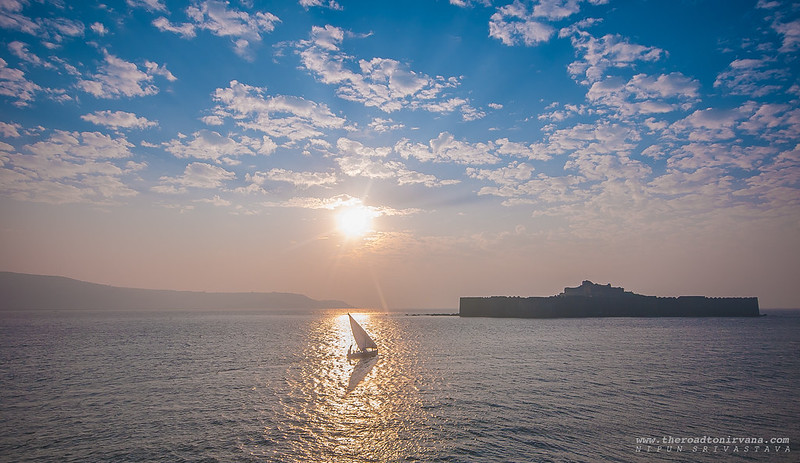
The Janjira Fort
I, for one, am always on the lookout for such places. Sometimes, between the rigorous audits and the worrisome tax calculations, it is all but natural to get that feeling – the feeling to get away from it all. Even if it’s just for that one night two night sojourn.
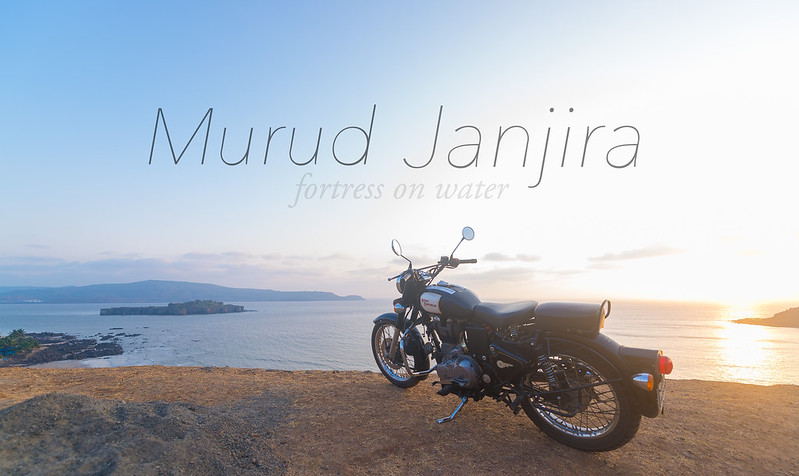
Murud is a small coastal village. The thing about Murud is that one doesn’t even realize how close it is from the highly commercialized and run down beach towns of Kashid, Alibaug and the likes. A meager 12 kilometers down the road from Kashid, lies Murud and the adjacent hilltop village of Janjira.
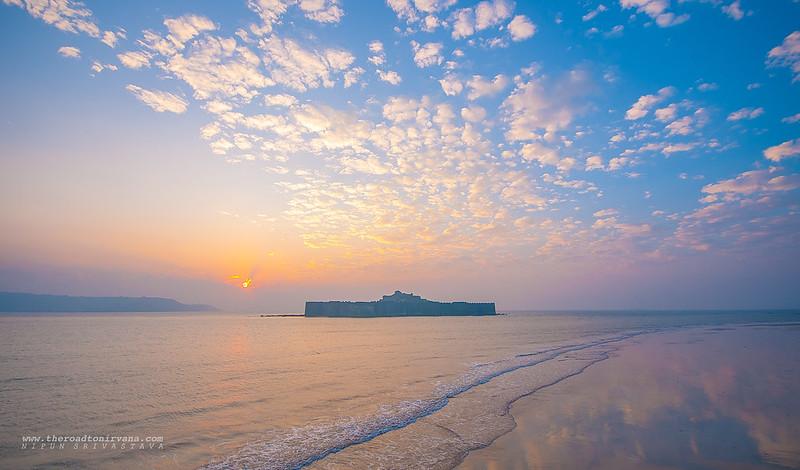
The main reason for travelers coming here is the day visit to the Janjira fort. Standing tall in the middle of the Arabian Sea, it is visible from the Janjira village (also from the road which leads to the village). The fort is a brilliant sight during the evenings of January and February as the sun sets just beside the exterior walls.
One can take a 20 minute sail-boat ride across the waters, which will reach you to the entrance of the Janjira fort, which is when one notices the innovative construction techniques used while building this medieval building.
On the way to the fort, in the boat (while you are hanging on for dear life), your boatmen will give you a very brief historical overview of Janjira fort. In the most flamboyant of ways, one of the boatmen will narrate to you the story behind the mammoth water locked structure. This narration is free of cost of-course but the boat ride will cost you 20 INR to go to the fort and come back. The monologue lasts around 10 minutes and the second boatman then doubles as your guide at the fort – a further setback of 20 INR to your pocket i.e. if you choose to go with the guide.
You can of course head out onto the fort by yourself. Negotiating the fort interiors isn’t too much of a hassle. Just remember, the last boat to the mainland leaves around 6pm.
Our group of bikers chose to head into the fort ‘with’ the guide. After the precarious boat ride across the waters, you can’t help but think to yourself ‘this better be good’. Good, it is for sure.
The mammoth arched entrance greets you out of the blue (quite literally, read: innovative architecture). The entrance to Janjira fort is built at such an angle that at first glance from afar, one can’t notice it. A feature incorporated to make it difficult for marauding powers to get on to the fort floor.
‘Jump!’ said one of my friends as I tried to gain balance on the boat while trying to change lenses on my camera, as the boat load of passengers hopped onto the jetty. All of us managed to get off the boat without slipping on the wet staircase under the tall stone entrance. A reasonable feat, if you ask me.
As you walk into the fort, a sharp right marks your entrance. The journey begins from the fort floor and takes you around the various verandahs and gun posts present in the fort. It is not very well preserved, this fort. Of the many things you will see inside the fort walls, by far the most intriguing are the two fresh water ponds, which are quite noticeable.
The queens palace lies in ruins, though is still a sight. Midway, during the tour, the guides will tell you that you have 15 minutes to climb to the top of a bunch of flights of stairs to the top of a flag tower and come back in time for the rest of the tour.
We climbed up; the view from the top is nothing short of breath-taking. Quite literally, huffing and puffing we reached the top of the tower, totting our cameras every step of the way. From the top, one can see all four corners of the fort and standing there gives you a semblance of the sheer size of the Janjira fort.
Depending upon the time of day when you visit the Janjira fort, the light will play out. I suggest that one spend the day getting to know the town of Murud, probably take a stroll through the market and then head to the fort around early evening. 3pm would be the perfect time to queue up for the ferry ride to the fort and then you can catch the sunset. In this case you will probably reach Murud town by nightfall.
There is another small beach right next to the jetty from where boats leave for the fort. It’s not a particularly clean beach and neither is it very beautiful but like most things in life, it’s beautifully imperfect. When I came to this place the first time, I chanced upon this stretch of sand and walked onto it with my camera. Within a minute, I was surrounded by children from the village nearby and I got some of my best silhouette shots ever.
The food situation here is decent. Murud is not particularly known for its cuisine but rest assured, you WILL find some tasty, taste bud tingling and semi-hygienic grub here. It’s a fishing village after all!
Head to the fish market after sunset and buy yourself some fresh catch. Give it to a local and let ‘em cook up your dinner.
Suggestion:
Golden Swan beach resort is an up-market and beautifully put together hotel/resort/restaurant situated on the beach, near the start of the town when you are coming from Kashid (or Mumbai). The food here is very good and hygienic as well, decent vegetarian options are available too. If you plan to stay here, it will cost you anywhere between INR 3500 to INR 10,000, according to your choice of rooms and the number of people staying put. You will love the people here and the free roaming ducks too!
(Personal favourite: The Chinese food here is great and the Solkadi (A refreshing non-alcoholic drink, a speciality of Maharashtrian cuisine) is pretty darn good!)
For the budget traveller, there are quite a few small lodges and homes where home owners will let you share a room or two for a price. The costing for this type of accommodation can range from INR 300 to INR 700 depending upon the class of the place.
There are some run of the mill hotels and lodges too but they are situated off the Murud beach and are honestly a bit of a turn off. So that is a choice you are going to have to make.
The beach at Murud would give you ample opportunities to lounge around doing nothing or well, whatever you may please! I loved the photo opportunities here. The nights are equally majestic with the stars lighting up the sea. Do take a mid-night stroll, it’s totally worth it.
A weekend trip is enough time to take in most of what Murud and Janjira have to offer. For me though, it’s not so easy. I have been to the place thrice, once with friends, once solo and once with my lady but thrice is never enough!
Take a bike ride. 170 kilometres from Pune and less from Mumbai, the ride to Murud will take about 4 hours.
Driving down is also a popular option. BUT. There is nothing worse than closed doors and rolled up windows of a car on serene roads.
You could also take the bus. ST or State Transport buses will get you to Kashid where a change of buses will see you walking the streets of Murud in no time. Be warned, these buses are seldom in good condition and almost always leave a painful mark on your back. Though travel in ST buses has a different thrill and it is also the cheapest way to get around.
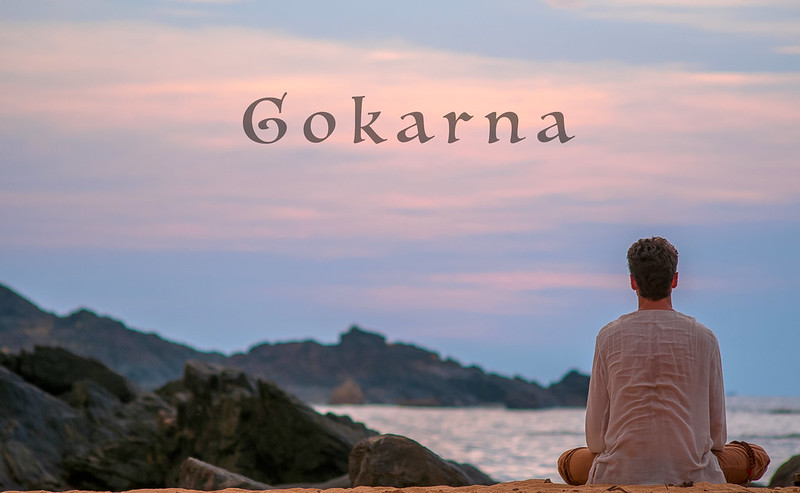
About 150 kilometers south of Goa, Gokarna is home to some really appealing beaches. Primarily known for its ‘hippy’ crowd, it is a magnet for foreign tourists who are on a budget. As always, we were on motorcycles.
welcome to Gokarna
It had been a real task getting here as Gokarna is about 650 kilometers from Pune. We covered that distance in a little over 13 hours of pure, unadulterated motorcycle riding through intermittent rain and losing our way while crossing over the Western Ghats. Here, unless you’re staying at the shacks on Om beach, it is next to impossible trying to search for a place to stay at in the night. So our suggestion, if you’re driving/riding from Mumbai, leave early. There are other options of getting to Gokarna like taking a train or even buses. Both the trains and buses are reasonably reliable and will get you there in one piece (if you cross your fingers ;)).
Gokarna town is chaotic and haphazard for the most part. We somehow find it beautiful. The place is full of people. Make no mistake this is only Gokarna town that we talk about. The vibe in the town is quite different from the rest of Gokarna.
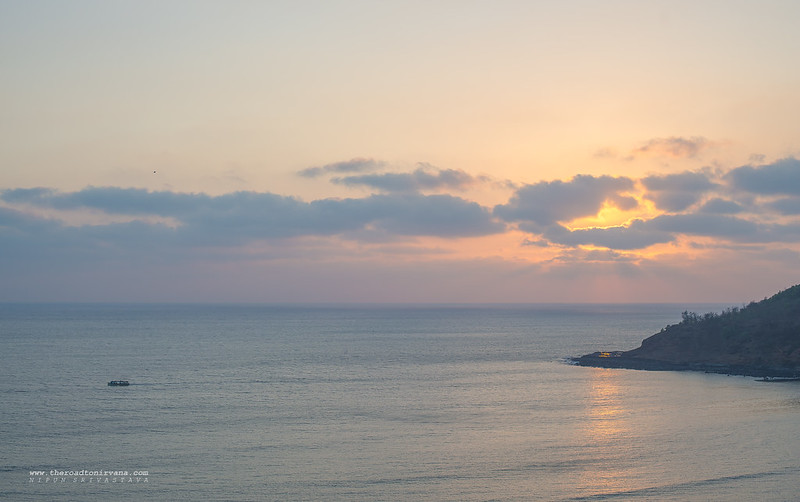
Om beach, which is about ten kilometers from the main town center, is the true Gokarn-ian destination. This stretch of smooth winding road gives you views of the Arabian Sea in the most flattering of ways. This small journey is very beautiful, especially during the evenings.
the spectacular view
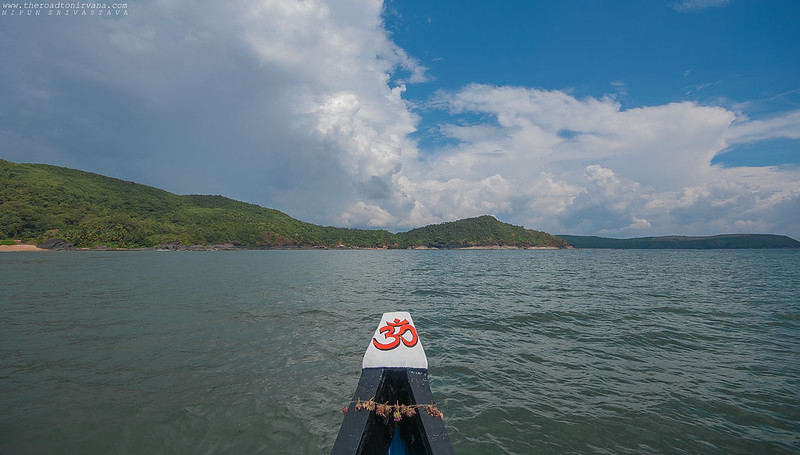
Om beach is so named because it looks like the Hindu symbol of worship Om (aum), when observed from a distance. A quaint and quiet calm prevails over this beach at all times. The slow pulsating waves that break on the golden brown sand titillate the senses and conjure peace in the mind.
om
A very endearing beach café and the only one of its kind, Dolphin Bay Café, sits right in the middle of Om beach. Appropriately named, you will often find many local boatmen with their boats lined up; ready to take tourists out to sea, to watch dolphins. Interesting as it may sound, we’re not sure about the environmental impact these shabbily organized and orchestrated tours actually have on the dolphins. It’s not healthy for their habitat in most cases, we’ve learnt. These boat rides are not very expensive and one can be hired for about 500 Indian rupees.
a titillating peace
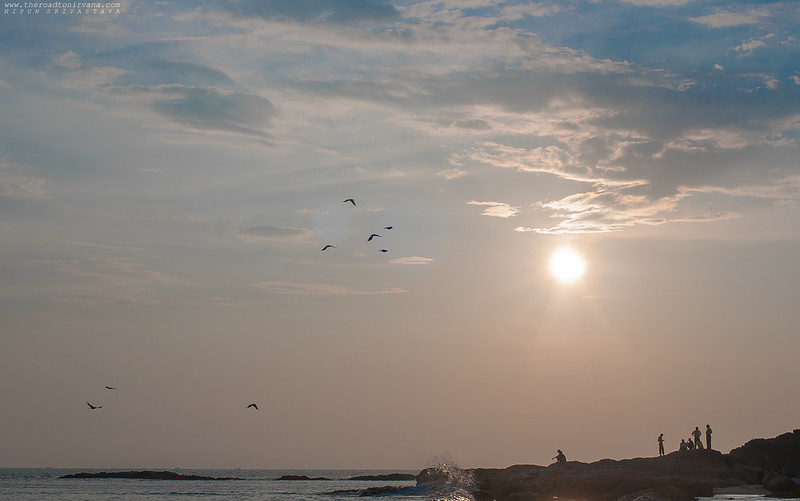
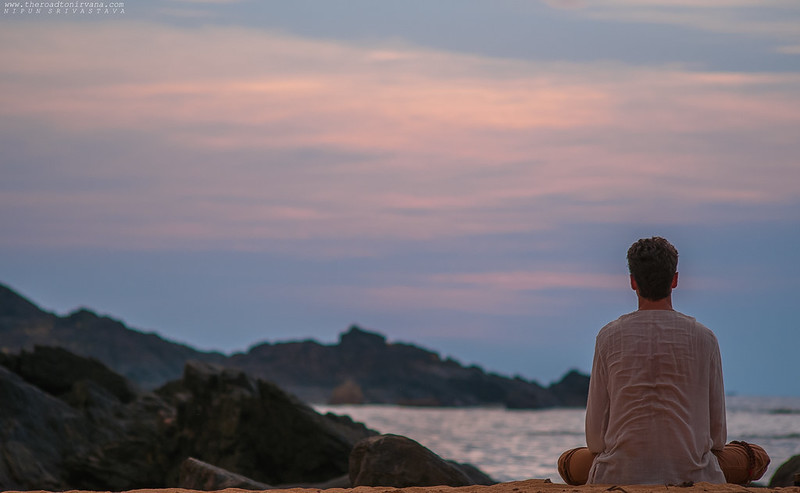
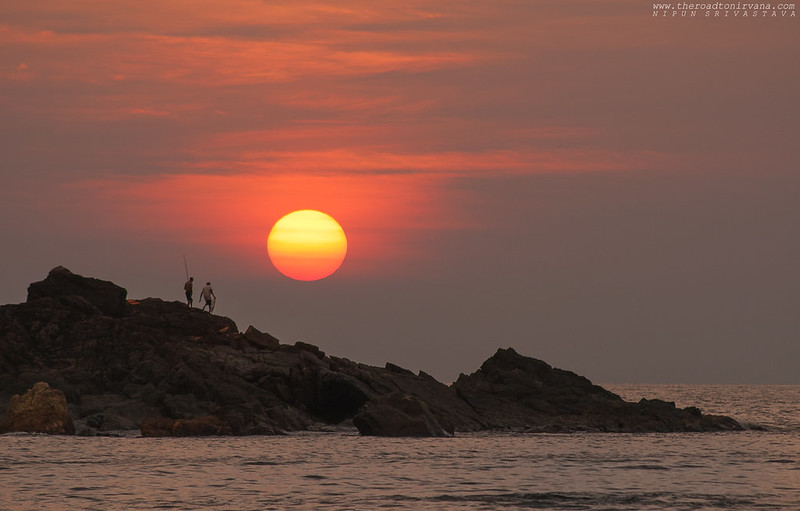
The Dolphin bay cafe is a very interesting place indeed. Laxman, the De-facto manager of the cafe will try and first- understand you and second- make you what you asked for. The easiest thing to order here, like anywhere else, is beer of course. Evenings couldn’t be more magical here, the color of the skies and the water are refreshing.
refreshing hues
In and around Gokarna there are a bunch of beaches which are not just beautiful but are also different from the regular run off the mill beach idea. For instance, Paradise beach, (yes!) Paradise is situated south of Om beach, about a 20 minute boat ride away. What’s special is that there is no access to this beach by land. It is also very small as far as the sand bank is concerned, which adds to its charm.
paradise found!
There is a huge restaurant on Paradise beach which serves very good Punjabi food. Also, for the offbeat traveller, there are shacks available. Why offbeat? Because once the tide comes in, the boats can’t dock on the beach. So you’re pretty much water locked on two sides and land locked on the other two. Staying here should be fun!
view from restaurant at Paradise Beach
Kudle’ and Half Moon are the other beaches around the town of Gokarna, Half Moon being the more remote one. They have a decent reputation and are of course very beautiful but plan to stay here only if you’re coming during the ‘season’. Else a passing visit to these two beaches is more than enough.
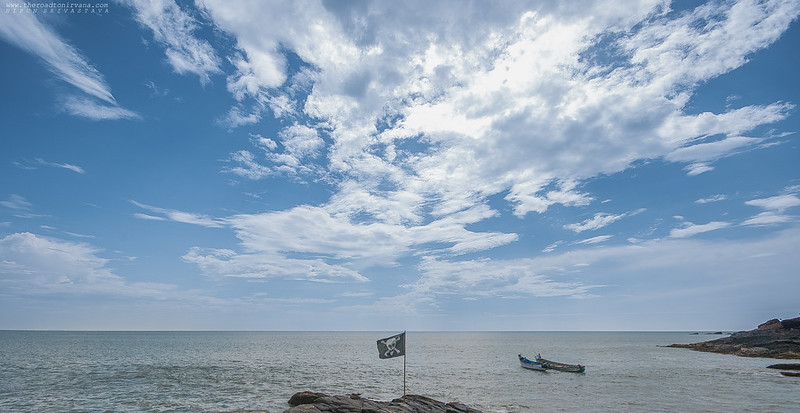
The beach near Gokarna town is also a pretty place. This beach is more interesting during sun up. Life here is an apparent presence, if you catch our drift.
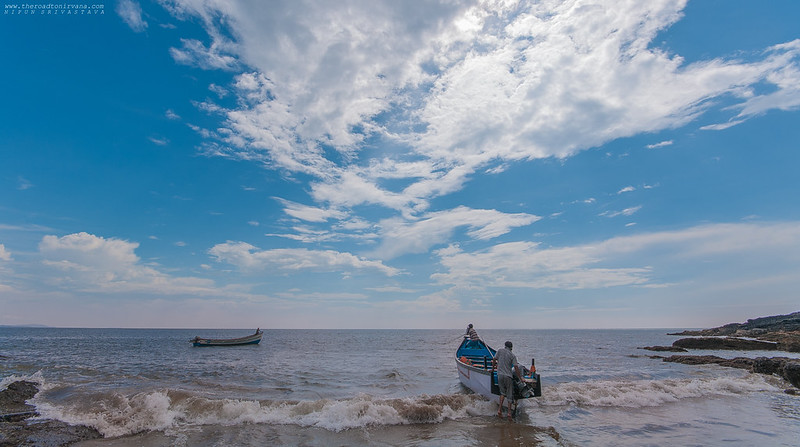
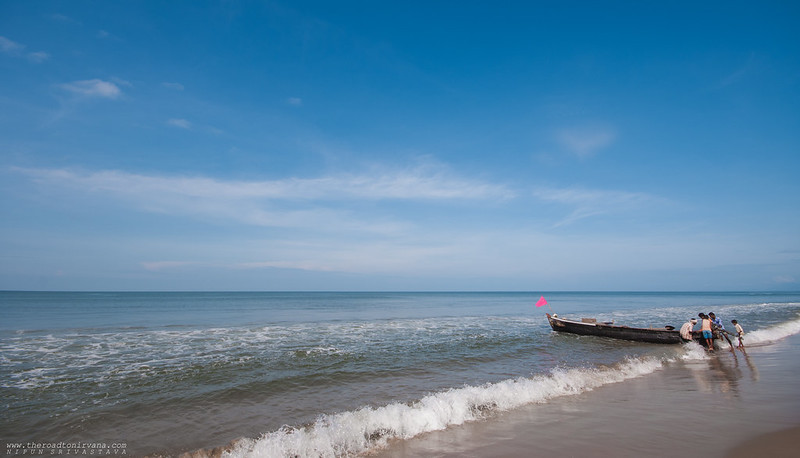
Every day, there can be seen whole families of fishermen heading out to sea to catch fish. This beach is a busy place, not in the tourist sense though. People here who live with the Sea, live off it too. Sure there are the cafés and the shacks and you might even find a couple of bikers with their tents pitched on the beach too. Gokarna though, has a lot more to it.
out to sea
Religion, predominantly Hinduism is a huge part of Gokarna. Temples and shrines present the real reason of existence for this town. There is a lot of folk lore about the ‘atmalinga’ which some claim rests at one of the temples here. Gokarna is home to a host of interesting avenues for those on a quest for knowledge about the religious aspects of this little temple town.
spirituality found
All said and done though, Gokarna is both for the lighthearted traveller as well as the one who finds solace in beer, bohemia and banter – not that the former doesn’t enjoy the latter. Anyone would simply love the aura of Gokarna.
Early in the morning, this sea weed farmer works on her square of the seaweed plantation.
In Zanzibar, the women mostly farm seaweed to sell to pharmaceutical firms from Japan and other oriental countries, where seaweed is used for skin treatments.
Give me a place I can be myself.
Give me the pleasure of connecting with my soul.
Give me my space to dream.
Let my essence come to the surface.
Let me, for my life back home, reccaliberate.
Let me sing my song.
I want to win the world.
I want to LIVE my life.
I want to fly.
Give me Hedvi.
The quintessential beach destination for any biker, come here to ‘touch’ your old self. Listen to your heart tell you what it really wants from life. Take a dip in the sea of peaceful waves breaking on the brown sand. Forget about where you came from. Head out towards where you want to be. Hedvi will take you there.
There is a lot more I can say about this haven. It is a special place for all us men and women the world considers as outsiders or weird. There is something about a flimsy shack near the beach, something about that voice of the ocean every time you close your eyes. That something which makes sweet sweat fall from your chin, that something which wakes you up early with the sun shining through bamboo weaves. Something, which is in drinking a litre of Solkadi every day that you spend here. What I can’t do is explain it with words, that something, it’s just Hedvi.
On the west coast of India, Hedvi is a small stretch of sand 200 kilometres north of Goa. Guhagar, another beach close to Hedvi is a major tourist centre. That is all anyone will tell you, especially us Enfield riders. Further, if you really deserve Hedvi, you will find it – On the road, on those two wheels standing in your garage right now.
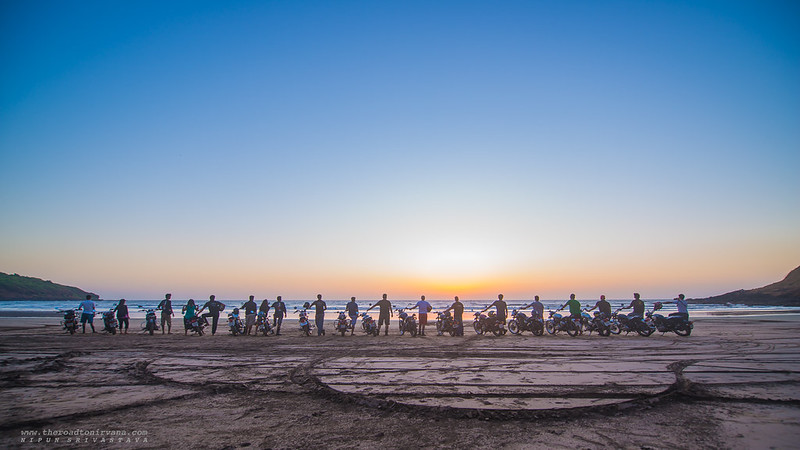
Sun, sand and sea.
Take the Nh-17 and head out towards Goa if you’re coming from Mumbai or the north. Remember one thing, if you’ve reached a place called Chiplun (coming from Mumbai), you’ve missed the right turn towards Guhagar.
If you’re on the right track and lucky, you will see almost blank concrete sign posts telling you where you should be headed.
Ask people, that’s the easiest way to find the right direction in India. If you reach the beach without getting lost even once, do write me a mail. I’ll send over a bottle of wine. Honest!
Isn’t it just another beach?
So is Baga in Goa, Kendwa in Zanzibar, Murud – Janjira in Maharashtra. Hedvi is not the prettiest beach in the world but it is the most beautiful. If, you can understand the vibe present in this coastal village. I would say, take your time.
Do not head to Hedvi just for the heck of it, for that there is Goa and its booze soaked pleasures. Hedvi is for the mature traveller, the one who understands the depth of travel and is ready to put up with big fire ants.
If you’re the type who thinks a getaway is a place where you dance till you drop and drink till you puke with a Dj playing you’re favourites, you’re right in thinking that Hedvi is a bore. On the other hand, if you’re a Motorcycle man/woman, you’ll know what I mean when I say that we can dance and drink even at Hedvi, with a twist nonetheless.
To the beach we’ll ride.
What else is around?
Well, not that it matters when you’re at Hedvi but there are a couple of interesting temples around. There is one major Laxmi Ganesh Temple in the main village, located atop a small hillock. Vehicles can drive right up to the temple gates. There is a second smaller temple on Hedvi beach itself, frequented mostly by village folk.
Next, during high tide i.e. at night, you can make your way alongside the coast to the gorge. Every time a big wave comes in, water shoots up the gorge into the air. Getting to the gorge is a bit of a trek and you need to remember how you got there or else if the tide gets too high, you might end up getting water locked. This happened to a friend of mine and me once. Carry a big, powerful flashlight.
There is a small stream which runs into the sea on the beach itself. This is a great place for bird watching early in the mornings and awesome for photography at sunset.
Playing in the sand!
Food
First things first, the Solkadi at Hedvi is by far the best that can be found anywhere in the world. Solkadi is a Maharashtrian drink/cooler cum digestive. When in Hedvi, I personally forget about liquor and stick to this pink nectar. Made with Kokam and coconut milk, it will refresh your senses and give your pallet something to think about. All this while making sure you head to the throne soon enough. Worth it!
Solkadi. The pink potion.
Grub, for vegetarians at Hedvi is no problem as veggie curries etc. are easy to order and easy to prepare for the family with whom essentially you will be staying.
For non – vegetarians on the other hand, chicken is available. If you want fish you need to inform your hosts in advance. Mutton, if you want it, will have to be bought by you from the Guhagar street market and cooked by you too, if you can handle it.
The typical Hedvi meal.
There is only one spice option available here, very spicy, no matter how well you explain blandness to your cook.
Taadi – or the local intoxicant (drink) is also available here. You can see farmers climb up coconut trees (from which the Taadi is extracted) and bring it down for you! It’s a very harsh drink and is not for the faint hearted drinker.
Beer is available on order but don’t go looking for brands like Tuborg or Carlsberg. Kingfisher is available, be happy. There is always the option of carrying your own booze.
Stay and accommodation
Motorcycle Shack
Alright, so there are shacks and they aren’t really on the beach. Though there is a broad treeline between your only accommodation option and the beach. You will realise, this too adds to the beauty of the place.
‘Suruchi’ is the name of the place where you can stay at Hedvi. The hotel is named after the daughter of the owner, Mr Bhatkar, who is also a resident on the same property. There are two couples shacks and three couples rooms along with three slightly bigger halls which can be occupied by groups/big families etc. Hygiene might be a concern for people who’d rather nit-pick than enjoy a vacation. It’s no 5 star this place.
Hedvi Treeline
There is ample parking space here, right in front of your rooms – another reason for it being a hit with bikers. When you park though, make sure there aren’t any coconuts dangling over your vehicles. There is nothing worse than waking up to a nasty dent on your baby. Also, the ladies and waiter or two will make sure you get tea, water and solkadi to your hearts content all through the day. For the finicky ones, there is always the STD booth/grocery store. Yes, they keep cold mineral water.
Before you leave
You will want to make sure you don’t need to use your cell phone as there is no network here. You may chance upon a couple of bars of signal if you are on the beach. Otherwise, the only option to connect with the outside world is an STD booth in the village near the beach. That always works fine.
Evening at Hedvi
Fire ants are huge here, thanks to the coconut trees. Big, red and ready to bite! Don’t walk barefoot in the grass or you’ll end up jumping all afternoon. Scorpions and tree snakes also frequent this joint, you’re the outcast here, deal with it. For supplies, the STD booth in the village is attached to a tiny grocery shop where you will get basic stuff like hair oil and toothpaste. Don’t go looking for tissues or baby wipes, they are a myth in this part of the country.
Make sure you order your meal at least 2 hours before lunch or dinner or else you will have to suffer. Otherwise there is tea and solkadi available always.
For motorcyclists and specially Enfield riders, there are two local mechanics here, Sandeep and Dinesh. They can handle minor problems and small electrical troubles on your bikes. To call the mechanics, get in touch with Mr Bhatkar. Basic medical facilities are also available at Hedvi, there is a very small hospital, only advisable for first aid though. Chiplun, a town about 70 kms away is where good medical facilities are available.
Bonfires are a treat here, make sure you and your group experience this under the stars and in the shadows of the tall trees. Please don’t litter at Hedvi.
That’s the end of the travel jargon. Enjoy your trip to Hedvi!
P.S: You want Mr Bhatkar’s Phone number don’t you? Well, e-mail me and you’ll get it!
It is a village about 850 kilometers from Mumbai, it lies close to the town of Hospet in the Southern Indian state of Karnataka. Hampi is less a medieval ruin site and more a wonder of nature. The views of the landscape here are full of boulders and hills of boulders in various sizes and shapes. Hampi is a site located within the ruins of the Vijayanagar Empire. It is older than the medieval city of Vijayanagara and is still of much religious importance. Home to the Virupaksha Temple – the main center of pilgrimage here and dedicated to Lord Shiva.
On the banks of The Tungabhadra river which flows through Karnataka into Andhra Pradesh, Hampi is not just a religious stop for the Indian traveler but is also a place of wonder and amazement for the foreign tourist.
Below is a photographic account of what I saw at Hampi and also what I think of it.
On two wheels, one is never alone: My bike ride started from Pune, 600 Kilometres from Hampi. I chose to ride on the NH4 till Hubli and from there another 170 kilometres to Hampi.
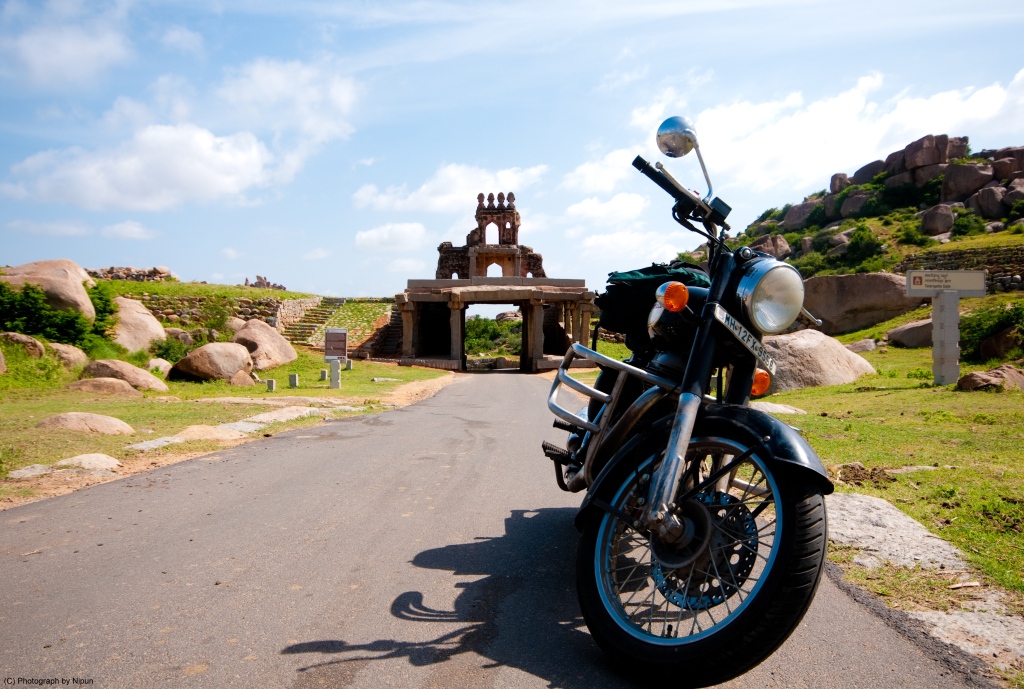
The gateway to Hampi
As one rides through the surrounding towns like Gadag and Hospet taking one towards Hampi, one starts to feel the excitement building up inside.
The entrance to Hampi does rather well to instil even more wonder into one’s mind.
The best season to visit Hampi is around September to November I would say, it’s neither too wet nor too hot.
God of the Gopurams
The Virupaksha Temple from the inside.
Major monuments in Hampi require you to buy a pass which is managed by the tourism department.
One drawback being that the passes are pretty expensive for foreign nationals when compared with tariffs for Indian citizens.
The land of perplexing opposites
Beautiful architecture and ruined rock – cut structures all claim the land.
On one hand, temples of the Vijayanagar Empire poke ones spiritual inner self and on the other the awesome expanse of ruins spread as far as the eyes can see make one wonder, how?
The Vitthala Temple Mahamandapa
This structure is in danger of falling apart, with every monsoon, more steel pillars are used to support and keep the structure upright.
The Stone Chariot at Vitthala Temple
This Chariot is by far one of the most enchanting pieces of carvings in Hampi. It is believed that the wheels are capable of revolving.
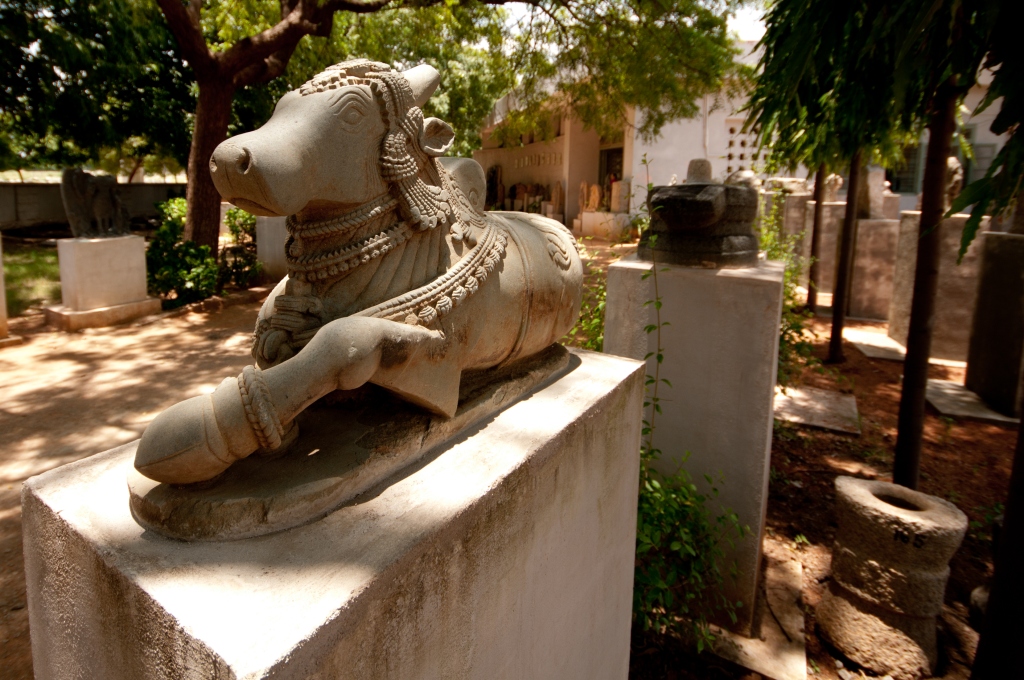
The Nandi Bull at Kamalapur Museum
The Museum has a vast collection of miniature carvings up on display.
Visiting the museum is a good way of spending a lazy afternoon here.
Also, next to the museum lie the grand elephant stables of the royal elephants.
Fusion Mansion
The Lotus Mahal is an awesome amalgamation of religion and culture. Huge arches on all sides and pyramidal towers. It is the best preserved stately monument at Hampi.
The Elephant Stables
Abode of the royal elephants of the ruler of Vijayanagaram.
Talarigatta gate
Hampi and Kamalapur, two neighboring villages and the roads between them are lined with these imposing stone cut gates built hundreds of years ago.
Dusk and the Virupaksha
In the evenings, the beauty of the place just reaches a whole new dimension.
Nandi temple. Way to Vijayavitthala. Mathanga hills
The sheer Magnitude of everything around, from the crazy rock formations to the imposing Gopurams of Temples just keeps one on the feet.
Walking trails and riding the roads through villages to get to even more sites of splendour.
—–
Colours of South India
Street photography in India is not the toughest of things to do.
The people of India seldom refrain from posing for a picture.
An example from Hampi!
This group of effervescent friends were quick to ask me for a picture.
What’s more, they didn’t even ask for a copy!
Strange things happen in India.
Only in India.
—–
The KSTDC tourist hotel
Karnataka State Tourism Development Corporation.
The rooms are neat and there are three types available, Regular, Deluxe and Super deluxe.
There is also the Presidential suite for the slightly extravagant.
Rs 3500 per night and President Pratibha Patil’s room is all yours!
The food is decent and your waiter will be more than happy to help out with special requests.
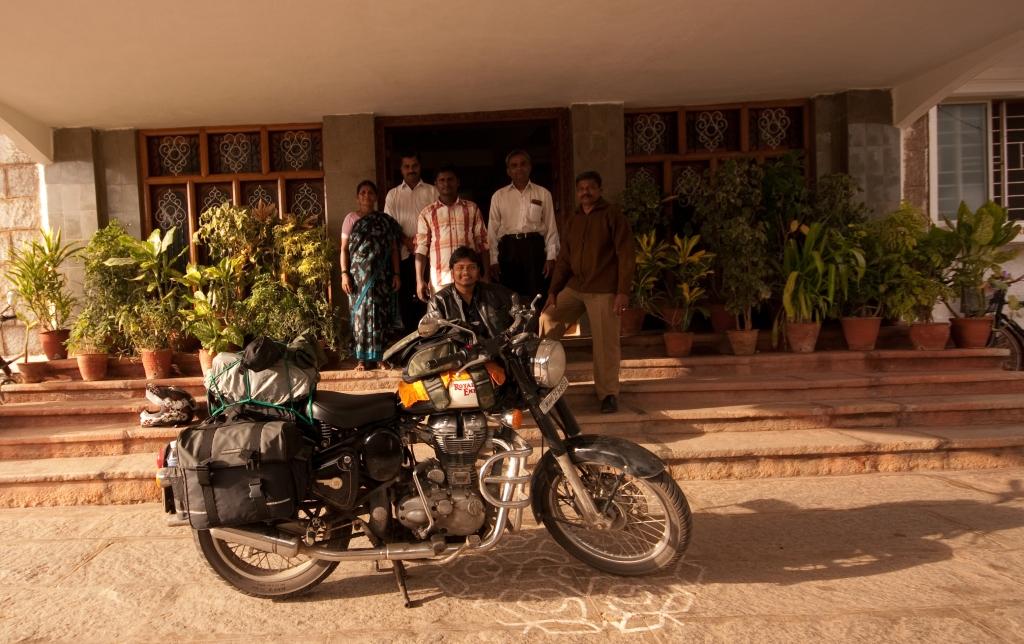
The staff at this KSTDC resort at Kamalapur, 4kms from the Virupaksha temple made my stay as comfortable as could be.
Right from warning me about the scorpions in the bathroom to making sure I had well cooked mutton for dinner every day.
Eeveryone here made sure that I took back memories which I would cherish for a log time.
Like every adventure, this solo bike ride was a learning experience. Not only did I meet a lot of different people, but also, learnt that life is beautiful and travel is the way to appreciate ones existence.
The Virupaksha Temple gopuram cradling the sun during sunset.



















 nirvana