Driven by IMAGE DRIVERS (India)

Latest

Why I ride

Why I ride

Once they asked me why I ride.

I told them, I take everything into my stride,
leaving a trail while through life I power slide.

So that others may have a guiding line.
So they too can break free from the grapevine.

This is how I live my life,
unencumbered and free from strife.

Challenges accepted are challenges won,
failure makes things even more fun.

They looked at me all wide eyed,
as I told them why I ride.

~ Nipun Srivastava

Photographs sometimes have a way of touching the innermost chords with their maker and the subject. These are personal pieces of art. They embody much more than just the subject and thought process. These photographs represent the philosophy behind whole existences. Entire life stories in a picture, meanings of entire lifetimes visualized through action and depiction.

Here’s one such image. The rider and I spent close to an hour composing and recomposing this particular photograph. Fading light and a slippery riding surface were two major constraints, this shot could have been better. But like somethings usually are, this image is beautifully imperfect. Enjoy.

The Motorcycle: Royal Enfield Classic 500.

The Camera: Nikon D 800.

Motorcycle rider: Vishal Kankonkar.

Photographer: Nipun Srivastava.

Motoring 2013!

Motoring enthusiasts like ourselves are defined by the thrill of travel. On wheels powered by engines, we traverse every kilometer we can afford. We ride and we drive, it’s who we are.

The Firelords have literally scorched the roads for over four years and here we are celebrating our power-slide into the fifth! Join us!

As an ode to our dedication for motorcycling and our ever-revving spirit, Ladies and Gentleman, we bring to you the Firelords Motoring Video 2013! Enjoy.

Do leave your comments below!

Big Toys Small Joys

Driving in India and off-roading are synonymous. Seriously! How we manage to drive our little hatchbacks and sedans is a mystery. Which makes the case for brute, no nonsense off-road vehicles.

Big toys, small joys.

We’re at the peak of the monsoon here, the roads are more interesting these days and so are the weekends. On one such interesting weekend, we drove ourselves to a tourist spot near Pune. Read on and find out what happened. No, not Lonavala.

There is something to be said for not caring about potholes while driving. Take it from us, that luxury is priceless. Not worrying about the underbelly of ones vehicle is a whole new level of nirvana, especially when one enjoys adventurous road trips.

Our choice of vehicle, the Mahindra Thar CRDe, is a 4×4 jeep made for the young and tough or rough or whatever defines men and women who don’t mind a little fun in the mud.

Big toys, small joys.

Some ask, is it comfortable? No, kind people, it’s a jeep.

Our particular version had a thick cloth roof which didn’t leak, too much. AND we had an air con which worked! The epic simplicity of a jeep is what is beautiful to us. It takes use, abuse, reuse and still keeps going like nothing else on the road.

We figure, as long as a person can deal with less than average driving comfort and above average maintenance interactions, this jeep is perfect. The Thar has a good engine for over-taking on the highways and doing your average off the road antic. Give the CRDe a smooth road and it will touch 140 km/h. Yes!

It’s planted too, more so than other jeeps which lack front independent suspension. Pardon the jargon. What we’re saying is, the ride is bumpy but you won’t hit your head on the roof. The Thar is a pleasure to drive on smooth and curvy hill roads as long as you keep it under 70 and have some rpm in your pocket.

It rolls just enough for you to get a cozy moment with you know who. 😉

Mahabaleshwar, surprisingly, turned out to be the perfect test run for this little doer. We drove through pouring rain in the day and as soon as the sun set, we found ourselves doing 10km/h in completely fogged out driving conditions.

For those who don’t know, jeep headlamps are some of the worst that were ever invented. Somethings that are well invented are roadside reflectors and footpaths! Literally tracing our path with the help of these aids, we reached our destination. Beer, food, sleep and back in the jeep.

We, being awesome, chanced upon an open table top mountain on our way back and stopped for a quick photo-session. Remember the joy of jumping in rain water puddles as a kid? We did that and a little more.

Big toys, small joys.

Lets splash that!

Tourist spot shmoorist spot. Thanks to the constant rain there was hardly anyone here, making our pictures look like they were taken in the middle of nowhere. That’s the thing about jeeps, rain/slush/snow only excites the driver. There were no damp spirits here!

Big toys, small joys.

Okay, I’ll play alone.

Hard core off-roaders would probably not like this turbo version of the jeep too much. The ECU controlled engine dynamics can sometimes make a tricky situation trickier. But, that’s not to say that the CRDe Thar is bad at off-roading. It can handle pretty much anything that the average enthusiast can throw at it.

Big toys, small joys.

I can go anywhere!

So, we think this jeep is a perfect all rounder. All this when it’s completely stock with no modifications. We know, what’s a jeep without modifications right? There you have it, even when stock, the Thar is a damn fine vehicle. We’ve had our eye on it for a while now, who knows, you might see the nirvana brand jeep rolling alongside soon!

Also, in our bid to encourage motoring conversations further, we’d like you to comment below and tell us what you think. We’d love to know how our readers satisfy their cravings for the road! Cheers!

Special mention:

Vishal Kankonkar: His jeep!

Gir and Gujarat

Early this year, we hightailed it through the Indian state of Gujarat in a car. A 2500 kilometre long journey packed into a tight 4 days. They say the best journeys are the ones that are planned the least. This mad drive into Gujarat was exactly that. One crappy car and four drivers can do a lot more than one might assume.

Gir and Gujarat

Gir and Gujarat

Our biker friend, Pankaj Goyal, was getting married deep inside Gujarat and we had to be there to bid our boy goodbye. We drove endlessly and under the cover of darkness in mid January. Swapping driving and navigation responsibilities at every rest stop, we saw the sunrise. While we were still on the road and now only about 50 kilometers from our destination, our minds started wandering.

Gir and Gujarat

Wanderlust

500 miles from home, it was imperative that we make the most of our journey. But, time was short. We met our friend and his lovely fiance, stayed and shot the wedding (our first wedding shoot evaar!) and then darted out into the vastness that is Gujarat.

The Gir national park and wildlife sanctuary is very popular amongst tourists and hardcore photographers. To be true, all our wildlife gear was sitting pretty back at base! Our photography, cameras and lenses were optimized to shoot a wedding, not the wild!

Gir and Gujarat

Trails

Thus began our trip to Gir, the final stronghold of the Asiatic Lion.

This was the first time any of us were visiting this part of the country. Yet again, we started our drive in the night. Gujarat, in India, is synonymous with ‘development’ or so we thought. We drove into the interiors and were taken by surprise, the roads in this part of the country were abysmal. To make matters slightly more challenging, the gates into Gir National Park did not open till 8am.

We snoozed in our car till a shabbily dressed, half asleep forest guard let us in. At 8 am and on the outer boundary, things got worse. As one drives into the sanctuary, roads virtually disappear. This was bad news for our overloaded car. Our speed was less than an average of 25 km/h.

Gir and Gujarat

Nothing but nature

They say everything happens for a reason and after 2 hours the slow, irritating and bumpy early morning drive bore fruit.

We saw her, as she walked protectively behind her two cubs. Protective but not concerned, we were on her turf. The four of us suddenly froze, as if in a daze. She was aware of our presence, we shut off the engine of our car. Just for a second, she turned to look at us.

Gir and Gujarat

I see you

That was the moment when the photographer in us took over. Before she could look away, we had our shot. That little moment felt much longer when we were in it. In her gaze, she sized our vehicle up. We were no threat.

Just as soon as we had clicked a couple of photos, she turned and walked away. As if she knew she had given us what we wanted, our first sighting. Before even entering the safari zone, where people go weeks without a single sighting, we had met the Lioness.

Gir and Gujarat

Luck and a Lioness

It was clear, luck was on our side.

We reached our campsite cum hotel a little after noon. All four of us were eager to try our luck at catching a glimpse of another Lion. We just had to go on safari. A completely modified SUV, optimized for carrying up to 6 people arrived to take us around the forest.

Our group of four was allotted one of the longest safari routes through the main forest. Our driver and spotter (Forest department registered) were adept at telling us about every aspect of the flora and fauna here. Albeit in a routine and practiced manner.

Gir and Gujarat

Dust, grime and a whole lot of fun!

One hour into the safari and having seen just a few hundred deer and buffaloes our spotter got news of a Lion sighting over the radio. We reached the spot with about 25 other jeeps already waiting at a distance.

A safari at Gir is rather amusing. There are unsaid practices here which make sure the paying tourists get their shots.

Sightings at Gir are actually enabled by people called ‘Trekkers/trackers’. These Trackers are local villagers hired by the forest department to patrol a designated piece of land. Their job is to relay the presence of Lions in their sector to the higher ups.

There were a lot of tourists at this sanctuary, the kind who come for the heck of it and not for the value forests of such nature hold. There were mammoth lens toting photographers too, who maybe didn’t care about the way they got their shot, as long as they got it.

And then there was us. Four confused guys, on a safari in India for the first time. We didn’t have our lenses but our conscience was alive. Sort of.

Gir and Gujarat

Spotted!

Here’s the truth about Gir. Everybody wants a sighting but not everybody gets one. It is sort of possible to ‘arrange’ for one to get a proper sighting. If a Lion has been sighted, drivers and forest guides act as if their vehicle has broken down. Then, once everyone else has left the spot, one ‘pays’ the tracker and gets the shot one wants. The moment guides/drivers learn that you’re interested in taking pictures, the offers come up.

We were gifted with another sighting. A slumbering male Lion, snoozing in the afternoon shade, lying on a carpet of dry grass.

Gir and Gujarat

FlatLioned

The Lion was lying flat on the ground. Looking at us photographers the tracker walked to a bush and shook the branches, which alerted the King. It looked up to see what the commotion was about. We all got our shot.

It is at this point that I realized the sorry state of the wild here. Yes this was a forest and yes the Lions were free to roam the boundaries of Gir, but there was something missing. That thrill of the chase, the chance of getting lost. And the sheer convenience of looking at these Lions had made this a very mediocre wildlife experience.

The only issue we had to deal with was dust. Which, had we been prepared, would not have caused us any discomfort.

Gir and Gujarat

My land exists but my wild is lost.

Gir is simply not what it is cracked up to be.

We had our share of fun. Buttered paranthas in the biting cold, under the stars and around the bonfire, licking pickles of unimaginable potency with me carefully keeping my distance from the sweet Gujarati Daal.

We had to be heading home, people among us had work to get done. But the disease of travel is such that it never leaves you cured. We took the long route out, stopping over at Somnath to check out what the temple holds.

Gir and Somnath

Somnath, the forbidden temple.

It was a lackluster trip once we left the wedding but as any good road trip is incomplete without its share of mishaps, ours was yet to give us the final challenge.

On our way back, doing three digit speeds, we lost our brakes. Yes. The game was still on!

At a remote dhaba, we waited for 5 hours as a mechanic charged us a bomb and got us new brake pads. Then, we drove for a thousand kilometers and reached home. Safe.

This land holds secrets, too many to count on ten fingers. Gujarat.

Shooting Stars

Exceptional photography – team that up with top of the line motoring and one gets an epic combination of style, class and charisma. Here’s a quick run up of a shoot we did early in January 2013 which has got us on the world map.

Ever visited a quarry? We did, epic thanks to our friend and fellow motoring enthusiast Vikram Dhoot. Dust, grime and amazing chicken curry led to the shots you will see below. We decided to go four wheeled this time!

We spent the day (and night) at this mammoth mortar making quarry. Not only were we breathing through our T-shirts all the time but this shoot was a proper dust test for our equipment as well. We had quite a few cars lined up as part of this shoot but today we talk only about one very special machine.

The vehicle is a 1980’s Mercedes Benz W123-200. Enjoy.

As the Sun set, we finished our tour of the premises and settled down for a spot of tea (we love our tea!). Our team now consisted of one photographer and more than ten accompanying enthusiasts. We slotted the Mercedes sedan for the night.

It was essential to take the surroundings into our photographs. The amount of dust on the vehicles was also something we tried working into the shots.

So here we go.
Quarry kid

Alive!

The image is alive. So is the processing plant at the quarry. We shot this image at about 12am and boy, was it an experience!

The sky was at its acme of clarity and so the following picture was inevitable. This was a welcome change from our usual motorcycling infused travel photography. We tested a bunch of new camera equipment too, the pictures you see here are all shot with a brand new Nikon D800! Check out the view!

80's motoring

The epitome of 80’s motoring in India!

If you haven’t already noticed, the car is a Left Hand Drive W123-200. This particular car is a 2 litre, four cylinder petrol. From North America and across the world to Japan, this car has seen almost every terrain the world can offer. The W123 was the most popular Mercedes sedan of its time, selling more than 6 million units! Which brings us to our next photograph.

Shooting the star

The star.

In one day, this photograph championed more than 40000 likes and favourites on Facebook and Instagram. This one image registered more than two million views. Mercedes Benz, Stuttgart, themselves pinged us and asked for the picture. This, friends, is the next step.

June 2013 Update:

These pictures have now gone on to become the face of Mercedes Benz Museum’s Classic car photo competition!

Like the Mercedes Benz Museum facebook page HERE.

View and participate here: http://mb4.me/ShootingStars

They even named the Photography competition after our article! Enjoy!

We thank:

The motorcycle men and women of the Firelords – for their ever awesome, ever annoying and forever dear to us assistance.

Vikram Dhoot – for the hot food, his car and his quarry.

Mercedes Benz – for their fantastic motoring.

If you have an awesome car and want awesome photography, get in touch!

Accidentally awesome photos!

CHANDRESH KUDWA

Photography & luck, the eternal duo.

We’ve all been lucky. We’ve all landed up with pictures that we love out of sheer luck haven’t we? One just has to admire the presence of luck in photography. It carries us through some of our most challenging photographic moments.

There are a few per-requisites to getting these sometimes surprising images.

First and foremost:

Well, there’s your camera. You don’t need a so called ‘high-end’ camera, really. What you will need however is a camera which is ready for a shot at all times. Fully charged and ready to roll.

All DSLRs these days have a stand-by mode. Like in my Nikon, the stand-by mode keeps the camera sleeping. The moment I need to take a picture, one press of any button will get it out of its slumber and ready to fire.

What’s even more important is that your camera be configured in such a way that it’s ready for all scenarios. You don’t want to be fidgeting with the settings to get the ISO down and the aperture up in case you need to point the lens at the Sun.

The solution to that problem is to keep the camera set to ‘auto’ or ‘P/Program’, when you’re not shooting something in particular, obviously. Let the camera do the work, it’s faster than your fingers in situations where you may have all but one second to point, compose and shoot.

As this black and white image demonstrates, being unprepared is not always a bad thing. (not that I condone it)

Two faced tide.

Two faced tide, Zanzibar, Africa.

This photograph, taken from the Forhodani Park in Stone Town, Zanzibar, showcases the simple life of the fishing community here. Every morning they head out with their sails open while the sun is still yawning into its rise. They return with the days catch in the evening, fresh and ready to go onto any of the stalls which line the lanes of the Forhodani park.

This is a much adored photograph from my portfolio but the harsh truth about this photograph is that this was a highly over-exposed frame. Shot in RAW, when this image came up in the scroll, there was little my mind could think about doing. The highlights were too bright, the blacks looked as if they came straight out of a can of oil paint.

The first thing that I did was to instantly rid it of all saturation (you know, cut my losses and use what I have). The next step came as a surprise even to me, I bumped up the exposure even more till the ocean looked almost like a sketch. You can even spot the horizon if you’ve got a good pair of eyes. As a result came out this picture postcard image of a Dhow.

Having the camera set to manual and not prepared for this type of photograph actually helped me capture this rather representative image. I was lucky. The unorthodox processing of this image saved the day.

Timing is everything, true.

There’s no getting away from it. Your shutter release has got to be absolutely on the money at that second when it’s all supposed to happen. Miss it and all you’ll have is a photograph which could.

Get it right though and you’ll be jumping with joy after you finish processing the picture. There again is that element which we all love to hate – luck.

The spirit of the desert.

Spirit of the desert. Rajasthan, India.

Easily one of the top 5 favourites from my recent trip to Rajasthan, India. I pride myself on the exquisite timing of this photograph.

I’m feeling lucky:

There have been a few times that I have ended up depending on luck. Some frown upon that but who gives a damn? They say that the photographers who rely on luck are not true photographers, they’re just trigger happy shooters. I think whoever says this is right, only to an extent though.

You see, I started shooting with a manual camera and its bathed in wasted film (and money!) disappointments. Back then it was only those ‘lucky’ shots that kept egging me on to shoot more.

Even the urge to try and better understand the nuances of making a well thought out and calibrated photograph was fueled by those few perfect photos. All thanks to luck.

Kumbhalgarh

A bad photograph gone good. Kumbhalgarh Fort, Rajasthan, India.

I didn’t even know I had taken this shot. I was busy watching the sound and light show at the fort (hence the lighting). The camera was set up on a tripod right next to my seat. With a wired remote-release in my hand I kept clicking, only occasionally changing the tilt to adjust my frame. The reason I love this photograph is that everything in the frame is perfectly out of focus. Yes! Look closely and you’ll see. Yet somehow, this image works. You can even see the milky way!

Light and Luck:

When shooting outdoors, these two factors can mean the world to a photographer. Also, no one has complete control over either. That’s what’s amazing if you actually do end up with a good photograph. Sometimes even the worst hours of light can yield a good photograph. Don’t be apprehensive about shooting at noon or under thick cloud cover. Go for it, regardless.

Oh! Zanzibar.

Living on an island. Zanzibar, Africa.

Shot at the top of noon, this photograph came as a surprise. Background: It was hot, I was sweating it with all my camera gear on my back and I was on a beach with no shade. On a motorcycle ride across the island, I had little control over the time I reached a particular destination. Look at this picture, see the shadows and you’ll know it was shot at 12PM on the dot. This photograph was a stepping stone for me towards realising the possibilities of shooting with harsh light.

Wing it!

Sometimes though, one just has to forget everything and swing for the fence. Like in this photo here, shot at Hampi in Karnataka, India.

The Virupaksha Temple, at Sunset.

Jewel in the crown. Virupaksha Temple, Hampi, India.

Almost 2 kilometers away from my subject and on top of a hill. The place where I was standing had absolutely no space to move around and get the Sun perfectly resting in the Temple’s crown. To get this particular shot, I had to literally hang off the hill and try to shoot with one hand stretched out as far as possible. The Sun too would stay in the correct position for a very short while only, I had very little time to execute. Adding to my problems was the 300mm lens that I was using! It took about 10 shots till I got this photograph. Which could have been taken in a better way, if I had a helicopter or something. (wink!). After I got the photograph and a few other shots, I spent the night ogling at my camera screen!

So there you have it. Go ahead and be lucky!

Go beyond.The Enfield in us. Hedvi.Somewhere I can find peace.

Stop. EAT. Go. Pune.

Www.theroadtonirvana.com

Pune, a city known for its many facets. A place which is as metropolitan as can be. That city where people like us come, make a life and only seldom leave. There is a lot in Pune to keep you hooked and I know you won’t argue when I say that the city’s food too works like a charm. Right from the road-side tapris or handcarts that serve us with our flaming hot cuttings of chai to those high end and lavish spreads of cuisine, everything is here to be liked.

I’ve spent close to five years in this city, going to college and making a career for myself. In that time it has been easy to tumble along and move through the streets of Pune one full tummy at a time. It’s been fun unearthing some real extraordinary and sometimes mighty different foods in Pune. The city is home to some killer street food. For anyone who values cuisine, the scene here is set.

Here are three special things that we will show to you in this article. Three completely different kinds of grub. A three stop vegetarian foodie trip through Pune.

Heads up: Special thanks to Yogesh Shinde for being a part of The Nirvana Team this time round!

Jhatka Bhel

Www.theroadtonirvana.com

Since the early 1900s the Shivajinagar railway head has been an important station for travellers coming to and heading out from Pune. Now a days, it is jam packed with all things travel. Right from passenger trains and locals fetching and delivering the masses to and from their daily destinations to big red busses crowding the road in front of this old railway station. The reason for this organized rush hour mayhem is the people of the city, their travel and their journey through daily life.

Www.theroadtonirvana.com

The Shivajinagar railway head.

Something as routine as the thousands of people who pass through the gates of this station is the Jhatka Bhel stall here. Tucked away in the lower right-hand corner, just outside the entrance, this stall is small, quiet and to the point. Since 1951, this oddly named bhel stall stands here. Feeding travellers with just one simple concoction of basic Indian ingredients. Bhel Puri, in this part of the country, is as old as tradition itself. It is a sweet/savoury melange of puffed rice, fresh cut onions and tomatoes, coriander, spices and tamarind chutney.

Www.theroadtonirvana.com

Bhel ka Jhatka!

On the go, this quick fix dish makes for an apt fuel. For those of us who value quality and quantity, a portion of Jhatka Bhel here at the Shivajinagar station is just perfect. What makes this particular Bhel Puri even more special is the story behind its peculiar name and its existence altogether.

The year was 1951 when a man named Yedunad Prasad Yadav started hawking at the Shivajinagar railway station. Over time he got himself a rented cubicle on the right hand side of the station’s entrance. That ordinary looking cubicle still stands today, now run by Yedunad’s grandson – Radhesham Yadav.

Www.theroadtonirvana.com

More than half a century of Bhel selling prowess has gotten the Jhatka Bhel its share of dedicated patrons.

Story behind the ‘Jhatka’:

It was originally known as Bhel Puri. But Yedunad Yadav had a unique style of putting all the ingredients together. As he went about making a portion of the popular Indian Chaat, Yadav jolted his head to one side in a peculiar albeit amusing way. Those frequent head bangs lent their name to his particular Bhel concoction – Jhatka Bhel.

Back to the future, Radhesham who has taken his grandfather’s place in the shop since 1994 doesn’t headbang while making your bhel but the original taste remains and so does the name. Radhesham goes about selling the bhel in a nonchalant and almost stoic way. Talking only while taking orders and delivering over the counter. Quite the contrast, we would say.

Www.theroadtonirvana.com

Radhesham, doing what he does best!

G.S. Gaikwad, a regular at the Jatka Bhel stall says that the ‘good chutney’ and ‘kadak crispy’ rice puffs have had him reaching for his bit of bhel since he was a kid! That’s pretty much the story with most patrons at this stall, they swear by Radhesham’s preparation. So much so that sometimes people miss their trains just so that they can eat the Jhatka Bhel!

Www.theroadtonirvana.com

Gaikwad and other patrons line up for their share.

When here, one can’t help but notice the attention to hygiene and cleanliness. Radhesham and his customers make sure they do not litter. There are no utensils used at all, except the bhel mixing spatula of course.

Www.theroadtonirvana.com

Sign in Marathi: Do not litter the platform, use dustbins.

The snack is served in a folded piece of broadsheet and the spoons are makeshift too. Like little shovels, patrons use the thin cardboard pieces as spoons. This would be heaven for eco-mentalists and health-freaks! At INR 15 a portion, a tummy-full of ‘get going grub’ is in everybody’s reach.

Www.theroadtonirvana.com

Stop. EAT. Go.

It’s an explosion of flavours, the Jhatka Bhel. Much like everything else that’s Indian.

The Nirvana Verdict: We rate the Jhatka Bhel at a 3.5 on 5.

Shegaon ki Kachauri

Www.theroadtonirvana.com

Not just any Kachauri, this. Selling like hot cakes for the past 56 years in the small town of Shegaon, the Shegaon-ki-kachauri has made its way to Pune. Much loved here too, we might add!

Scores of people throng this roadside shop just off J.M. Road everyday. At eight bucks a piece, these little pockets of fried pastry pack a good punch. Piping hot, deep fried, spicy and compact – the perfect food for a city goer.

Www.theroadtonirvana.com

The Kachauri heap.

Image by Yogesh Shinde.

The Kachauri is a popular Indian snack. It’s a round, deep fried and savoury pastry filled with a spicy stuffing. It’s a real rage all year round in Indian households and each house has their own recipe for the filling. The Kachauri even boasts of a good shelf life and hence is even more popular.

Www.theroadtonirvana.com

A Kachauri cross-section.

Image by Yogesh Shinde.

Shashikant Sharma, manager of the Kachauri outlet’s J.M. Road shop told us that he’s been selling the snack for over five years in Pune. He says that the Kachauris have a cult following here. Not just Pune, Sharma tells the Nirvana team that apart from Shegaon and Pune, the snack sells well in places like Nagpur, Amravati and even Mumbai. He’s mighty proud of his product.

Www.theroadtonirvana.com

A camera-shy Shashikant with his Kachauris.

“Nowhere in Pune will you find the taste which you’ll get in our Kachauris” Sharma boasts. We agree!

Mehul Shah, who works with Just Dial stays nearby and swears by the Shegaon Kachauri. He says he’s eaten many a Kachauri but none match the taste which he finds here. Shah is a regular at the joint.

Www.theroadtonirvana.com

Mehul Shah, getting his grub.

Freshly fried right next to you, the piercing aroma adds that much more zing to a brilliant snacking experience. Fair warning, this snack is highly addictive when served hot and is very high in calories! Watch it!

Www.theroadtonirvana.comWww.theroadtonirvana.com

How it all happens!

One concern that we did have was the hygiene of the cooking environment. It could put some people off.

This outlet is open throughout the day, on all days.

The Nirvana Verdict: We rate the Shegaon ki Kachauri at a 4 on 5. It’s that good!

Kharwas

Www.theroadtonirvana.com

Travelling through the streets of Pune, it’s not uncommon to come across something one hasn’t experienced before. Look what we found for dessert!

Kharwas is not your ordinary dessert. It is a sweet meat made out of a cow’s first milk, just after it gives birth. The texture is like a smooth cheesecake and the taste may need to be acquired for some.

Www.theroadtonirvana.com

Saffron and Cardamom flavoured Kharwas.

Very high in protein, this unique sweet dish is known to increase body heat. Don’t be going anywhere close if you’ve just discovered you’re pregnant. Known as Barri in the Marwadi language, Kharwas is popular amongst Puneites in flavors such as Kesar (saffron), Elaichi (cardamom) and pistachio.

Www.theroadtonirvana.com

Eating Kharwas.

Describing it as a unique and special sweet meat, owner of the corner shop Mr. Krishna Pardeshi tells us that he has been selling it at this very spot for over ten years. His Kharwas shop – Yashaswi Sweet Mart, is so well tucked into the street corner that it’s hard not to miss.

Www.theroadtonirvana.com

Mr. Pardeshi.

Just off J.M. Road, on the road going towards the famous ‘Z’ bridge, his shop can be seen on the left. There’s no drama here. Just a humble Mr. Pardeshi serving up Kharwas by the plate.

When the inquisitive Nirvana team asked Mr. Pardeshi how he procures so much ‘first milk’ everyday, he smiles. He then goes on to tell us that he contacts owners of buffaloes and cows all over the city and then gets them to sell the special milk to him. Quite a logistical feat we think!

The Kharwas here is fresh, sweet and at 18 INR a portion it’s quite a departure from the now common in Pune gelato/mithai experience. Worth a shot for sure!

The Yashaswi Sweets shop is open from 5pm to 10pm, all through the week.

The Nirvana Verdict: We give this unique sweet a 3 on 5.

All aboard!

So those are our three not-so-run-of-the-mill (vegetarian) eats from the city of Pune. Do feel free to comment and leave suggestions for new and interesting foodie destinations. The Nirvana Team is always ready for good grub!

Flashback Zanzibar.

A much delayed article. A year late, to be precise. There are some things in life that happen out of the blue. Like this brilliant (professional) life starting trip. I got to work with two of the most accomplished and inspiring editors I know. Read on to find out about Zanzibar and my 30 day trip to the island in early 2011.

Flashback Zanzibar!

As a photographer, I had decided that Africa was a place I’d visit only when I felt completely prepared. It’s an overwhelming continent, something I’m sure everybody knows already. More so for a photographer I can report. Thing is, with its grave prospects for downright dumbfounding photography (for the viewer and photographer alike), the continent of Africa had intimidated me for quite some time. I had hence decided within my head that I would venture into that part of the world only when I, as a photographer, was better ready.

All that changed in an instant when I received my confirmation email from Mambo Magazine. Mambo was a travel/culture online magazine based in Zanzibar, Tanzania. Yet again, my life had managed to trump my game plan but I wasn’t complaining! I was to spend a month on the Island of Zanzibar, interning as a photographer and writer. I took off.

When you first reach the Island of Zanzibar, you may feel like this is not the quintessential African destination but rest assured. Zanzibar is as African as Africa gets. There is wildlife, there is culture and there is the experience of a lifetime.

Untitled

Getting there

Zanzibar lies about 35 miles off the coast of Dar-es-Salaam, a part of Tanzania in east central Africa. I took a 20 minute flight to Zanzibar from Dar-es-Salaam. One can also opt for the ferry which takes about 2 hours to get you there. Both options invite you into this grove of uniqueness with absolutely stunning vistas. Whether you look at it from the air or while racing across the Indian ocean, this archipelago is a treat for the senses.

Once on land I found that life here is laid back. Nobody here is in a hurry, ‘Pole pole’ as they say, slowly slowly. People here are friendly and are completely at ease with tourists. Tourism being the main industry in Zanzibar, the main town known as Stone Town revolves around the traveller.

In Stone Town one notices how life here is like any other tourist town but with a slight twist. Zanzibar is home to many different ethnicities, right from Indians to people from the Middle East and of course the African Swahili. The various cultures and people here coexist in a beautiful mixture that is bound to catch your attention and keep you enthralled. As you walk through the maze of narrow streets and lanes that is Stone Town, you will see small shops on both sides of your path selling local art and souvenirs. One can find scintillating paintings of the forests and the Masai and even abstract which are capable of capturing the attention of the most discerning connoisseur.

Road side shoppe

Street side!

For the food loving kind, the by-lanes of Stone Town offer authentic Swahili street food in addition to the retro barbeque and grilled preparations of sea food and meats. Make your way to Forhodani park and you will be treated to tens of vendors selling grilled sea food such as fish, shrimp and octopus right off the grill!

Untitled

Forhodani Bbq!

A dish called ‘Urojo’ is a local delicacy, it is a savoury soup and is very healthy and filling – perfect for the weight-watchers. Kassava chips are a popular local munch. If you’re a little fussy, almost every cuisine in the world can be found here, right from the best pizza and pasta from Italy to lassi and tava biryani from India. If you’re feeling lavish, head to the Serena Inn, a Stone Town five star, for a pint of Kilimanjaro. Overlooking the ocean, this little escapade will refresh you at any time of the day.

Title Shot for the bar.

A pint of Kili

Stone town is also home to a lot of beach cafes, such as the Livingstone. It sits right next to the ferry terminal and hence is always surrounded by interesting happenings, the staff of the Livingstone will also make sure that your time at the resto-bar is worthwhile and that you leave with a stomach full of grub and a spring in your step.

The Livingstone Beach Cafe.

The Livingstone Cafe

The Swahili culture is a very unique one indeed. The women here wear colourful attires and although shy at first, they won’t mind if you ask before taking a picture. Even the clothes worn by the locals have interesting angles to them. The ‘Kanga’, a type of head gear worn by the local women has interesting quotes printed on them which have a hidden meaning. Women communicate amongst themselves and with their husbands and friends using these Kangas, without speaking a single word!

Let's buy some furniture in Zanzibar!

Vibrance in cloth

Zanzibar is the birth place of Swahili. The language is not too tough to grasp for the average traveller, basic Swahili is easy to pick up. ‘Jambo’ a word which means hello, ‘asante’ which means thank you and for Indians, ‘Pilli Pilli’ which stands for chilli is enough to get you through your vacation in paradise here. Even if you’re not a language person, the cheerful spirit and energetic charm of the locals will coax you into learning a few words. Don’t be surprised if you hear people using some Hindi words, for instance the word ‘bas’ stands for enough, just like in Hindi.

Jambo!

Jambo!

You get the full tourist experience in Stone Town but if you want to see the real thing, head out. I recommend renting an SUV and taking a drive across the island. That way one gets a chance to really gain a feel for Zanzibar. But, even that is a tad touristy if you ask me.

For the hard-core traveller who really wants to discover this place inside out, I suggest you hop onto a ‘Dalla-Dalla’ or a local bus and hang on! These are small Toyota trucks modified to carry a monumental number of passengers. It’ is the perfect way to break the ice between you and the experience. These trucks/busses are the lifeline of the island. Make sure you loose your inhibitions before hopping on though!

Do the Dala Dala!

Do the Dala Dala!

Being the biker I am I took a six day motorcycle ride across the island and its various beaches/villages. A motorcycle ride according to me is the best way to experience the openness and beauty of Zanzibar. The exhilaration of riding along the smooth roads which mostly run parallel to the coast and feeling the cool ocean breeze is incomparable to any other pleasure. Every spot on the island has a completely different feel. I spent a month here and still can’t wait to get back. Read more about my motorbike ride here: The Magical Motorcycle Tour.

Biking it in Africa!

Bikin’ it in Africa!

The villages are a complete contrast to the town. Hardly any shops, empty roads and the sounds of the Ocean. Stay on the east coast for a couple of days and experience the beautiful sunrises over the calm waters of the Indian Ocean.

Go beyond.

Sunrises here leave one speechless.

Party? Make your way to Kendwa – it’s the party king of Zanzibar. A great place to chill out and meet fellow travellers. On the west coast, you will be treated to amazing sunsets every evening. Rest assured, you’ll have a story to tell from here!

The penultimate eve.

Postcard sunsets

Distances are short here, if you’re in a car. In a couple of hours one can cross the entire island from North to South. The roads are good too but once you’re in a village, be prepared to ride through some sandy patches. It is all great fun though.

Untitled

Road to nirvana! Wink!

Zanzibar also has great wildlife. The Jozani national park in the centre of the island is home to the African Red and Black Colobus monkeys. If you are lucky, you might even catch a glimpse of the native Blue Monkey. The guides of the park will take you through the forest foliage and past huge centuries old Baobab trees. They will help you track down the whereabouts of these playful tree dwellers.

The African Red Colobus Monkey.Who are you?

The Red Colobus and Blue Monkeys.

If you have the guts, head to the Zala Park. Zala is a reptile sanctuary managed by two inspiring locals who have dedicated their lives to conserving wildlife on the island. The park is home to some of the most dangerous snakes in the world like the Green Mamba and the Cobra. Who knows, you might even get to hold one.

The snake man.Untitled

Zala Reptile Park!

Dolphin tours are also very popular with the tourists here but there is a catch. The excessive tours operated here, some say, are leading to the detriment of the dolphin population. I steered clear of this option to be honest. If you’re lucky, sitting on one of the pristine beaches of this wonder island, you might just get to see the dolphins playing out in the ocean.

Untitled

The southern shore

Take the sea safari on the east coast though. That will give you a guided insight into the daily life of the people living in the coastal regions and will take you close to the culture of the real Swahili Zanzibaris. See how the local women make a living by farming seaweed and making rope from coconut fiber. It’s quite the learning curve!

Sea Safari.

Sea Safari!

When you want more, take some Swahili cooking lessons. Learn what they eat, how they cook and help do it. Enjoy a cosy meal with one of the local families, right in their home. Take in the cheerful hospitality while you drink coconut water and talk to the family. On this island, even a month is less time!

Be it for the honeymooners, backpackers or even adventure freaks, with its myriad avenues when it comes to that extra ordinary travel experience, Zanzibar will see you bowled over. Whether you are looking for a week away in a foreign land or even planning to take your family along for a different kind of trip, my suggestion is, head to Zanzibar and let the Swahili vibe take over.

Untitled

Perfect mornings

For me, Zanzibar was an eye opener. Mambo and I did a photography workshop on the last day of my trip. It was the first time I was going to be teaching! The workshop was a roaring success! House full!

Untitled

Cameras love Zanzibar!

In more ways than one this trip managed to force open my mind and instill in me the confidence needed for the coming year and it’s travel. Africa does that to you. Do visit, it’ll do you a world of good.

Untitled

Karibu Zanzibar!

To see more pictures from Zanzibar – Click here.

Links:

Top ten photographs from my trip to Zanzibar – The Zanzibar Post.

An in-depth Island experience: The Magical Motorcycle Tour.

Swahili cooking: Click here to read.

The Sea Safari: What lies beneath.

Travel article in the Pune Mirror on Zanzibar by Nipun Srivastava: Click here to read.

For any further information regarding travel/cuisine/entertainment/safety in Zanzibar, contact: www.Mambomagazine.com

Rooh – E – Rajasthan: My Journey Home!

Part 8 of Rooh – E – Rajasthan.

To read part 7 – Click here.

To read part 6 – Click here.

To read part 5 – Click here.

To read part 4 – Click here.

To read part 3 – Click here.

To read part 2 – Click here.

To read part 1 – Click here.

Lets go home.

ROOH - E - RAJASTHAN

Twenty eight wonderful days had been spent on the roads and in the cities of Rajasthan. On this special motorcycle journey I had led a much disciplined and regulated life. You know, going to sleep early to get up in time for the sunrise more often than not. Also to leave early to reach the next destination on time.

My last morning here was different. I didn’t wake up on time. Three lines of alarms failed to get me out of my snooze on this day. I woke up with a jolt at nine AM when my mum called to check whether I’d left Udaipur.

I mean wow, I felt like even Rajasthan didn’t want me to leave. Letting me be as I revelled in deep slumber.

After I was awake however, it was a mad rush to get on the road. It took me an hour to get to the bike and load up. Hurriedly, I said my thank you to the hotel staff, tipped my favorite waiter and rolled on towards the highway.

Sooner than you’d think, with my bikes’ engine warmed up and us riding smoothly on the highway into Gujarat, I was again thinking back to the time I’d had in Udaipur and Rajasthan as a whole.

What can one say? When a place known for its harsh climate and shifting sands embraces you with a large heart, one can only feel humbled.

My motorcycle ride around Rajasthan had grounded me like no other escapade of mine. Only a long string of adjectives could probably describe what I felt or maybe even that would fall short of truly expressing how liberated I felt.

Homeward bound!

Homeward bound!

RAJASTHAN

The Land:

A complete and absolute assault on the senses. A place tailor-made for the wanderer and ponderer alike.

Rooh - e - Rajasthan 2011.

The sands of Sam

The people:

Positively one of the best behaved and most polite in India. Most cultures boast of being hospitable and caring but the folk of Rajasthan truly personify hospitality. They embrace their roots. One has to admire the people who respect and hold in such high regard their own culture, music and place of belonging.

Nakki lake.

The music of Abu

The food:

To be brutally honest, across the length of my trip, the food I had was mediocre. There were some stars though. Like the LAAL MAANS atop Nahargarh Fort in Jaipur or the super spicy Aloo ka parantha at Dudu! Even the Chaat at the Gol Piyau in Ajmer is worth a special mention.

The mehrangarh fort.

Food and thought

The experience:

It was just a thought two years ago, today Rooh – E – Rajasthan is one of my favorite pieces of work!

The rider and I.

A ride to remember!

Rajasthan was a challenge at first. A personal feat I have to say. Like one gets used to the temperature of water after diving in, I got used to Rajasthan’s ever-changing vibe. From the serene desert sands of Jaisalmer and Sam to the chaotic city life of Jodhpur and the commercial holiness of Pushkar, the feeling of finding myself in a different situation was ever present.

I rode on smooth straight roads, through suffocating sands over vanishing roads, atop camels, walked barefoot on warm evening sand, became a part of the music, made friends from different cultures and countries even, spent a month amongst strangers who I now call my own.

I felt more Indian than I’d ever felt before. I felt more human and alive than I’d ever felt before.

Favorite incident:

Chancing upon two musicians in Jaisalmer who became friends and delighted me with their art. Etienne ‘Suryaneel’ Lauth and Hariram Bhopa. They were as absorbed in their art as a glass of cold water would be in hot sand, they taught me to forget about the world and do what the heart asks. Let me not comment on the brilliance of their music as it was just beyond word.

Music in motion.

Etienne (Suryaneel) and Hariram

Most remembered photographic moment:

Shooting atop desert dunes.

As the sun went down over the horizon made up of curvy dues stretching out till the eyes could see, shooting here was a refreshing experience. I walked atop the dunes barefoot, letting the coarse grains of sand caress my sole. It ended up touching my soul. I felt peace.

The camel and its jockey.

The camel and its jockey

Shot of the trip:

Camels around my motorcycle on the highway. On my way from Ajmer to Jaipur. The image sums up my journey in a nutshell. The ride, the road and Rajasthan.

The final shot!

A different trip.

Three most loved Photographs of the trip:

My top three most adored photographs from Rajasthan, each of these photos represent a facet of my journey. Not just when it comes to storytelling but also technically. Each of these photographs have hours of effort behind them and also more technique has been used compared to any average image.

AamerROOH - E - RAJASTHANKumbhalgarh.

Aamer.                                                  Sam and sand.                                          Kumbhalgarh.

Best biker moment:

Looking at the road end and sand begin.

Where the road ends and the sand begins.

Sand locked

Final Haul home!

After about seven hours of riding through the morning and afternoon I had crossed into Gujarat and was soon closing on my night halt for the day – Ankleshwar. The town of Ankleshwar is built around industry and also happened to be my rest stop at the beginning of this ride. As I approached the town on my motorcycle I got stuck in a traffic jam! On the six lane highway, it was a situation I’d never been in. After about half an hour and probably moving only about ten meters forward, I decided to turn around on the same road and get off the highway. Yes it was dangerous but a man’s gotta do what a man’s gotta do. I rode on the wrong side of the road for a kilometer or so and reached an exit. Then I managed to find my way through another town which lay adjacent to Ankleshwar.

They say that everything happens for a reason and it’s true. As I rode through this unknown town towards Ankleshwar, I found myself at the start of a long and narrow bridge which stood over a wide river which I had to cross. The evening traffic was so much that I was literally wiggling my way through. As I rolled on to the bridge, a perfect and round golden yellow almost orange Sun greeted me to my right. Its reflection off the river was relaxing to say the least. I wanted to stop right there and click some pictures but there was absolutely no space and the traffic behind me was menacing. I had no choice but to store the memory in my head and move on. Just that bit of beauty was enough to take away the pain of my now eight hour long motorcycle ride out of Udaipur.

I was on my way home now. I stayed the night in a hotel and then pushed my bikes’ performance to the limit for the home run. She was close to seizing up, my motorcycle, I could feel it. An 8AM cold start is the last thing I wanted for her straining engine but we now had to crank it up and get home. On the highway again and racing towards the outskirts of Mumbai and Thane, we hardly took any stops. My mind was alight with questions about whether we’ll reach home on our own steam. I kept the throttle jammed open, the motorcycle responded like she knew what were trying to do, get home.

My motorcycle knew the fact that the trip was over and this was the most important part. Getting home often is. She probably knew that the only place she’d get the attention she deserved would be at the workshop in Pune and so we cracked on through the mid day sun. Soon we crossed into Maharashtra and then by noon reached the turnoff to Pune.

I stopped for lunch and also to give my motorcycle one final cooling rest before we hauled it to Pune. After lunch, getting back on the bike, I told her not to give up on me on this absolute last leg of 200 kilometers. It’d be a pity if we couldn’t get home now. These roads were known to the both of us, the team of man and motorcycle soldiered on till we reached the outskirts of Pune. One final water stop marked the end of my ride to Rajasthan. I was home.

At that overwhelming moment, what it felt like cannot be put in words. It was my longest ever solo motorcycle ride. An overall distance of about 5000 kilometers of motorcycling, tourism, photography and an experience of a lifetime had been achieved.

Just like Rana Pratap’s horse, Chetak, my motorcycle got me home and then proceeded to get herself to the workshop. Only then did she let her condition take the better of her. She’d gone through a lot, the desert heat, the grains of sand and my constant whims. It had been an epic challenge for her too. What a machine! What a personality and how amazing that she understood her rider just the way he was. The Marauder!

The places I missed:

Yes, believe it or not, there are a lot of places I didn’t visit on this trip. Rajasthan is huge and trust me when I say it is worth spending a sizable part of one’s life here. Each corner has it’s own story, it’s own people and it’s own shade of sand. When you go, keep in mind these places that I didn’t get a chance to go to.

Why didn’t I go?

Time was a major reason for skipping places like Bikaner and Alwar. Sometimes it so happened that I found out about a place only after I’d passed it, like Bundi and Gagaria. Rajasthan is like a big bundle of surprises, each place you go to can hide amazing sights which someone in a hurry may never uncover. The step wells in Jodhpur make up one such site. I only found out about them just before leaving. Thanks to my friend Oindrila Mukherjee – an avid traveller, I can share a few pictures which will demonstrate what a beautiful place I missed not to mention a fantastic photo-opportunity.

Step wells at Jodhpur

Step wells at JodhpurStep wells at Jodhpur

Photographs by Oindrila Mukherjee.

The thing is, it’s sometimes okay not to have seen a place in its entirety. For me personally I try to explore for myself as much as I can but then again – I’m the imperfect traveller. These places I’ve missed just make sure that one day I will head back. Because I’ve fallen in love with the land.
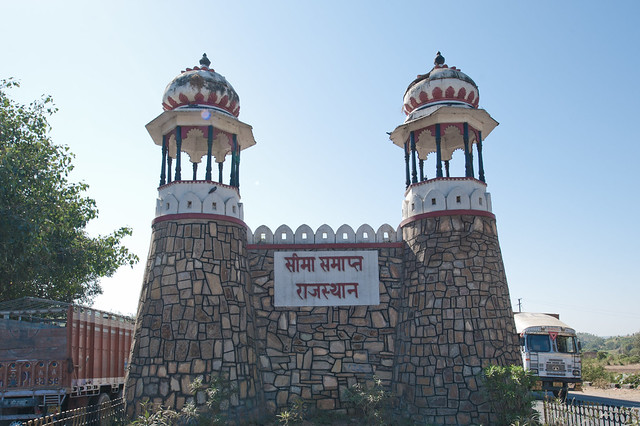
Seema Samaapt.

Rajasthan limit ends.

For more pictures: Click here.

——————————————————————————————————————————————————————————————————————————————–

In this article:

Number of nights: Ankleshwar = 1.

Distance travelled: Udaipur – Akleshwar – Pune = 860 kms.

Motorcycle condition: She survived! We did it. Crank assembly changed, block-piston kit changed, complete engine and mechanical overhaul done.

———————————————————————————————————————————————————————————————————————————————-

People I thank:

The Firelords, Pune – A motorcycle owners’ club of sorts.

Mount Abu:

Nathu ji – Musician.

Barmer:

Mr Madhav Singh Rajpurohit, Staff at Hotel Madhav Paradise.

Jaisalmer:

Mr Hariram Bhopa, Mr Kadam Singh – RTDC, Mr Etienne ‘Suryaneel’ Lauth, Mr Bismillah Khan and troupe, Sultan Bhai – Camel herder, staff at RTDC Moomal.

Jodhpur:

Mr Pankaj Srivastava – Punjab National Bank, Mr Kishor Kumar – RTDC, staff at RTDC Ghoomar, Bansiraam – folk musician, Mrs Laali Mukherjee.

Ajmer/Pushkar:

Mrs Geetam Saxena. Staff at RTDC Sarover – Pushkar.

Jaipur:

Mr Ajay Saxena – RTDC. Staff at RTDC Teej.

Chittaurgarh:

Manager – RTDC Panna, RTDC staff at the Chittaurgarh fort.

Udaipur

Mr Narayan. Staff at RTDC Kajri.

————————————————————————————————————————————————————————————————————————————————————-

Some travel for pleasure, some for adventure. Some go for others, I go for me.

The End.